

Ad Group (line items)
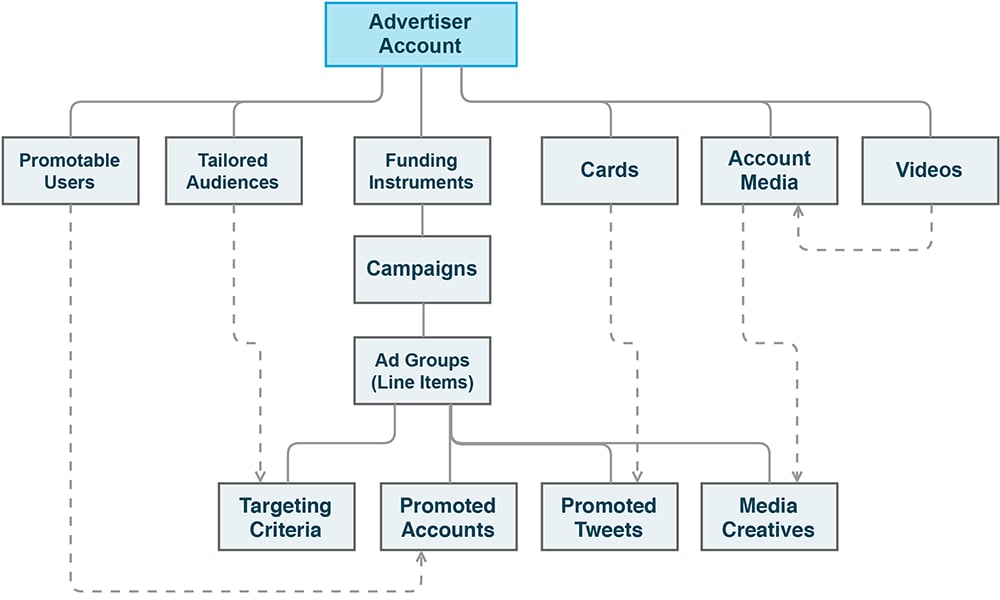
Ad groups, known as line items on the Ads API, exist under campaigns and are used for targeting and bidding against a set of X users. Advertisers promote posts or media (e.g., videos that are promoted as In-stream ads) by associating them with a line item. Also see Ad Group.Account Media
A collection of creatives that have been uploaded to an ads account as account media that can include promoted video pre-roll assets, also referred to as in-stream ads, and images that can be promoted on the X Audience Platform.Ads Accounts
At the top of the X Ads hierarchy are ads accounts. An ads account can be managed by multiple X users. @Furni, our demo furniture store, would be an example of a user who manages an ads account. We identify ads accounts by an account_id, which is a base36 alpha-numeric string. Under each account, we store a number of entity types that can be reused across campaigns, such as tailored audiences that can be used for targeting, account media, which are videos or images, and cards, which are expanded creatives that you can add to a post.Amplify Video
When uploading a video asset, the uploading entity can define a category for the video (e.g., Tweet Video, Tweet Gif, Tweet Image and Amplify Video). The amplify video category is required when trying to upload a video that is to be served as an in-stream advertisement. These videos require special processing to ensure that they’re servable and hence the media category of Amplify Video is required.Analytics
Analytics metrics help partners and advertisers understand the performance of the content they promote on X. This includes information such as impressions, clicks, video views, and spend. In addition, partners and advertisers are able to get detailed metrics for various segments of the audiences they reach. The Ads API supports two ways of retrieving detailed campaign performance metrics: synchronously and asynchronously. With synchronous analytics requests, the requested metrics are returned in the response. The synchronous endpoint supports short time ranges and is ideal for querying real-time campaign performance. With the asynchronous analytics endpoints, the requested metrics are available in a downloadable results file after the associated “job” has finished processing. The asynchronous endpoints support requesting metrics over a much longer time range, allows returning segmented data, and are intended for fetching much more data — ideal for generating reporting or historical backfills.Campaigns
Each campaign that the advertiser runs must be created under an existing funding instrument. A campaign lets you define things like the name, schedule, and budget of an ad campaign. In sticking with the example of Furni, we might create a campaign called “Furni home decor”. It’s worth noting that an ads account is limited to a max of 200 active Campaigns; this limit can be elevated by the advertiser’s account manager. A Campaign is deemed active until its end time is reached or its budget is exhausted. A paused campaign is still considered an active campaign for the purposes of campaign limits.Cards
Cards offer a way to visually extend a Tweet to include an image, video or UI elements. The Ads API supports several card types that can be used in Tweets, which can then be promoted in campaigns.Lead forms
Lead forms collect contact information in a native form on X. Attach a form to a card with aLEAD_FORM destination, then export submitted leads for a form and time window. Lead form identifiers are UUIDs.